Our research on Reconfigurable Intelligent Surfaces (RIS) focuses on transforming Massive MIMO-based wireless communication by tackling challenges such as pilot contamination and signal disruptions in dynamic environments. By integrating RIS-assisted beamforming with advanced optimization techniques and AI-driven models—including deep neural networks—we enhance channel estimation accuracy, mitigate interference, and develop efficient blockage prediction methods to maintain seamless connectivity. These RIS-enabled advancements significantly improve signal-to-noise ratio (SNR), spectral and energy efficiency, and overall system reliability. Together, RIS and Massive MIMO provide a powerful foundation for next-generation wireless networks, reducing latency, optimizing resource allocation, and paving the way for 5G-Advanced, 6G, and beyond.

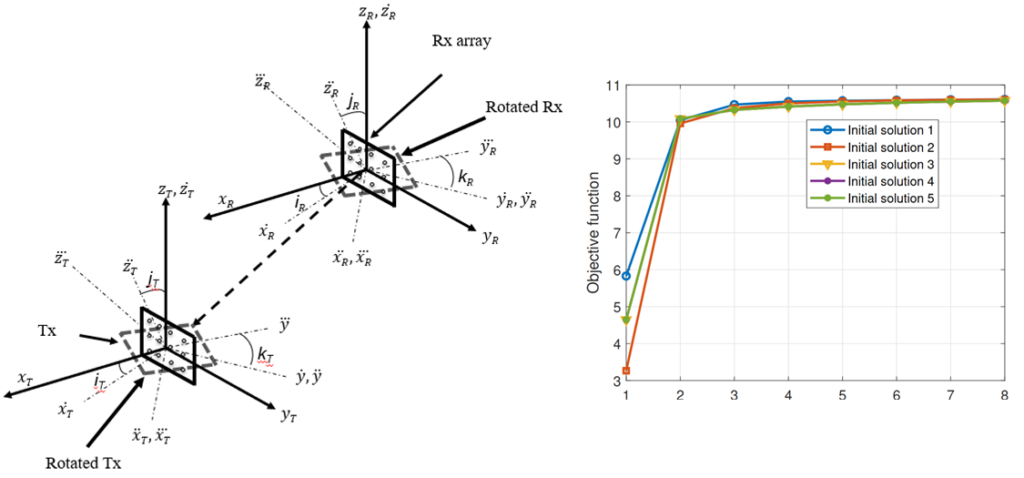
Publications:
- S. Ahmed, A. Kamal, and M. Selim. “Optimal Microcontroller Usage in Reconfigurable Intelligent Surface: A Batteryless IoT Systems Case Study,” Elsevier Measurement: Digitalization (accepted)
- S. Ahmed, A. E. Kamal, M. Y. Selim, M. A. Hossain, and S. R. Sabuj. “Optimizing Small Cell Performance: A New MIMO Paradigm With Distributed ASTAR-RISs,” IEEE Open Journal of Vehicular Technology, vol. 6, pp. 128-144, 2025.
- S. Ahmed, A. E. Kamal, M. Y. Selim, S. R. Sabuj, and M. Hamamura. “Revolutionizing Batteryless IoT Systems to Enhance Nonlinear Energy Harvesting Using RIS Active and Passive Elements,” IEEE Open Journal of the Communications Society, vol. 5, pp. 3021-3037, 2024.
- S. Ahmed and A. E. Kamal. “Sky’s the Limit: Navigating 6G with ASTAR-RIS for UAVs Optimal Path Planning,” 2023 IEEE Symposium on Computers and Communications (ISCC), Gammarth, Tunisia, pp. 582-587.
- M. Chowdhury, M. Shahjalal, S. Ahmed, and Y. Jang. “6G Wireless Communication: Applications, Requirements, Technologies, and Research Directions,” IEEE Open Journal of the Communications Society, vol. 1, pp. 957-975, July 2020.
- S. Ahmed, I. Abdelmawla, A. E. Kamal, and M. Y. Selim. “Blockage Prediction for Mobile UE in RIS-Assisted Wireless Networks: A Deep Learning Approach,” MILCOM 2022 – IEEE Military Communications Conference, Rockville, MD, USA, pp. 705-710.
- S. Ahmed and A. E. Kamal. “RIS Panel-Assisted Enhanced Edge Computing for Batteryless IoT Sensors,” ICC 2022 – IEEE International Conference on Communications, Seoul, Korea, pp. 5676-5681.
- S. Ahmed, M. Y. Selim, and A. E. Kamal. “Enhanced IoT Batteryless D2D Communications Using Reconfigurable Intelligent Surfaces,” IEEE 47th Conference on Local Computer Networks (LCN), Edmonton, AB, Canada, 2022, pp. 42-47.
- S. Ahmed, A. E. Kamal, and M. Y. Selim. “Adding Active Elements to Reconfigurable Intelligent Surfaces to Enhance Energy Harvesting for IoT Devices,” MILCOM 2021 – IEEE Military Communications Conference, San Diego, CA, USA, pp. 297-302.
- M. Selim, A. Nazar, S. Ahmed, and A. Kamal. “Adaptive Deployment of Reconfigurable Intelligent Surfaces on Tethered and Untethered UAVs,” Book Chapter, Springer Nature (accepted, 2024).
- M. Saeed, A. Khokhar, and S. Ahmed. “Deep Learning-Driven Cascaded Channel Estimation in RIS-Aided mm-Wave Massive MIMO Systems,” submitted to 2025 IEEE International Conference on Communications.
- K. Saeed, A. Khokhar, and S. Ahmed. “Pilot Contamination in Massive MIMO Systems: Challenges and Future Prospects,” 2024 International Wireless Communications and Mobile Computing (IWCMC), Ayia Napa, Cyprus, pp. 1504-1509.
- H. Sun, Q. Wang, S. Ahmed, and R. Q. Hu. “Non-Orthogonal Multiple Access in a mmWave-Based IoT Wireless System with SWIPT,” IEEE VTC, Sydney, NSW, Australia, Nov. 2017 (Invited paper).
- M. Alam, M. Rahman, S. Ahmed, and M. Chowdhury. “Adaptive Biasing Cell Association in FFR-Aided Multi-Tier Heterogeneous Networks Under Dynamic Load Variation,” IEEE International Conference on Informatics, Electronics, and Vision (ICIEV), May 2016, pp. 829-833 (Best Paper Award).
- S. Arnab, S. Alam, T. Mahmud, S. Sabuj, and S. Ahmed. “Deep Convolutional Generative Adversarial Networks: Performance Analysis in Wireless Systems,” Discover Internet of Things, Springer (accepted, 2024).
- S. Karobi, S. Ahmed, S. Sabuj, and A. Khokhar. “EcoEdgeTwin: Enhanced 6G Network via Mobile Edge Computing and Digital Twin Integration,” submitted to 2024 IET Digital Twins and Applications.
- M. Chowdhury and S. Ahmed. “A New Conditional Generative Adversarial Network for Massive MIMO Channel Estimation,” submitted to 2024 Arabian Journal for Science and Engineering (AJSE).
- S. Sabuj, S. Ahmed, and A. Khokhar. “Spectrum Scarcity in Vehicular Networks in 6G: Architecture, Challenges and Solutions,” in preparation for IEEE Vehicular Technology Magazine.
- S. Sabuj, S. Ahmed, and H. Jo. “Multiple CUAV-Enabled mMTC and URLLC Services: Review of Energy Efficiency and Latency Performance,” IEEE Transactions on Green Communications and Networking, vol. 7, no. 3, pp. 1369-1382, Sept. 2023.
- S. Ahmed, M. Z. Chowdhury, S. Sabuj, Y. Jang, and I. Alam. “Energy-Efficient UAV Relaying Robust Resource Allocation in Uncertain Adversarial Networks,” IEEE Access, vol. 9, pp. 59920-59934, 2021.